Understanding Leave Calculation
This guide explains how IceHrm calculates leave balances, including the accrual system, carry-forward mechanics, and how to view detailed calculations.
Example Scenario
Consider an employee who joined the company on March 20, 2015 with a vacation leave entitlement of 25 days per leave period.

Key Concepts
| Term | Description |
|---|---|
| Leave Period | The annual cycle for leave calculation (e.g., January 1 to December 31) |
| Accrual | When enabled, leave accumulates based on time served within each period |
| Carry Forward | Unused leave transferred from the previous period |
Viewing Leave Calculations
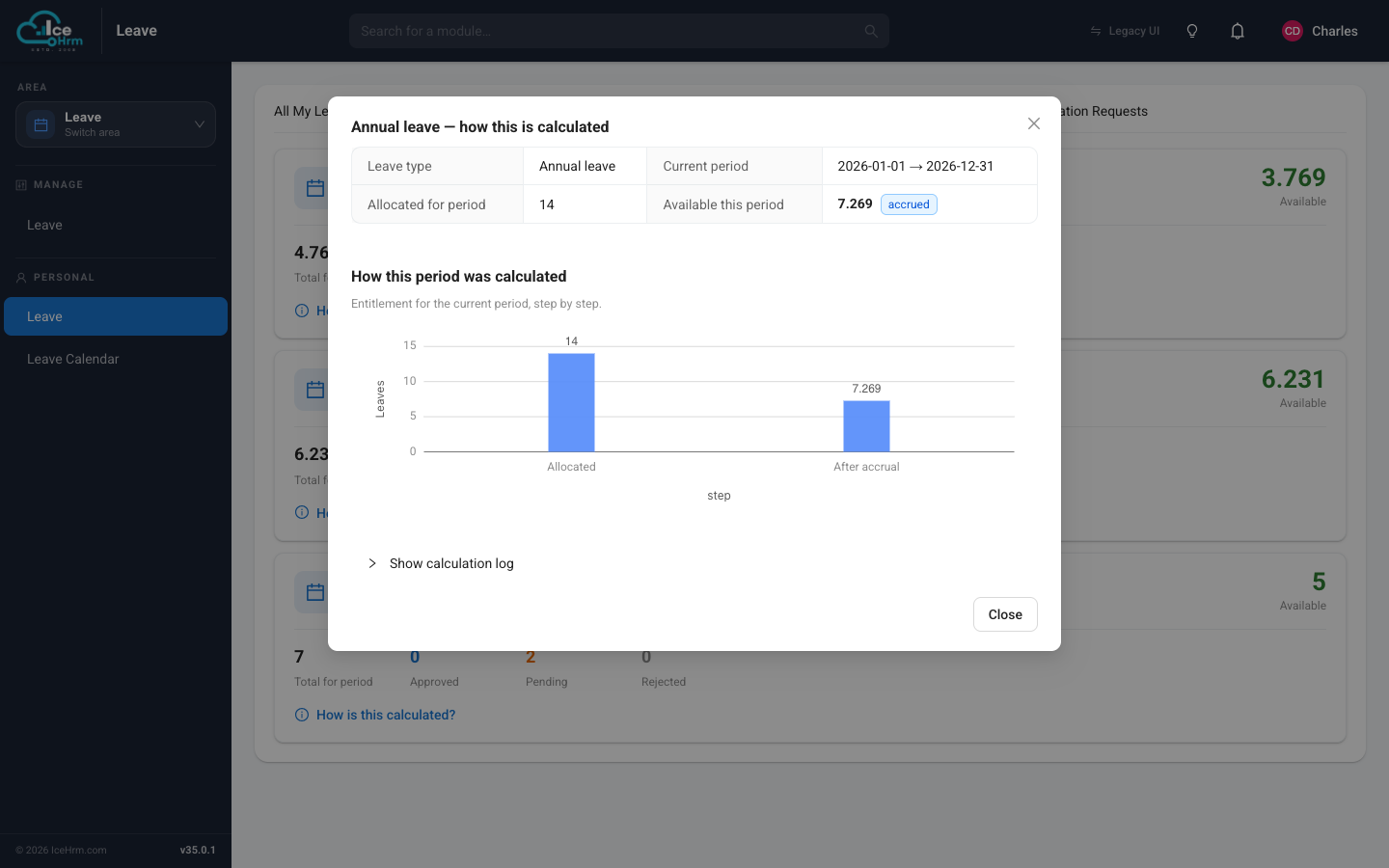
IceHrm provides a "Show Calculation" feature that displays a detailed breakdown of how leave balances are calculated.

Why Use Show Calculation?
The Show Calculation feature helps you:
- See period-by-period breakdowns
- Understand factors affecting entitlements
- Identify issues like negative PTO balances
- Avoid manual calculation errors
Calculation Example
2019 Leave Entitlement
For our example employee with accrual enabled:

| Component | Value |
|---|---|
| Leave Per Period | 25 days |
| Accrued for 2019 | 22.9 days |
The accrued amount (22.9 days) is calculated based on the time the employee has served within the 2019 leave period.
Multi-Year Calculation
The Show Calculation feature reveals how leave balances evolve across multiple years.

Example Breakdown
2017:
- No leaves taken
- Full entitlement carries forward to 2018
2018:
- Employee had -5 PTO balance (negative balance from previous adjustments)
- This reduced the 2018 entitlement to 20 days
- After taking 1 vacation day, the balance was 18 days
Formula:
Available Leave = Previous Balance + Current Accrual - Deductions - Utilized
Understanding Accrual
When accrual is enabled for a leave type, employees earn leave gradually throughout the period instead of receiving the full amount upfront.
How Accrual Works
| Setting | Example |
|---|---|
| Annual Entitlement | 25 days |
| Leave Period | January 1 - December 31 |
| Accrual | Daily/Monthly based on configuration |
Accrual Calculation
Monthly Accrual = Annual Entitlement ÷ 12
Example:
25 days ÷ 12 months = 2.08 days per month
By mid-year (June 30), an employee would have accrued approximately 12.5 days.
Understanding Carry Forward
Unused leave from a previous period can be carried forward to the next period, subject to configuration limits.
Carry Forward Settings
| Setting | Description |
|---|---|
| Carry Forward Enabled | Whether unused leave transfers to next period |
| Maximum Days | Cap on days that can be carried forward |
| Percentage | Portion of unused leave that carries forward |
| Expiry Period | How long carried forward leave remains valid |
Example
2023 Unused Leave: 8 days
Maximum Carry Forward: 5 days
Percentage: 100%
2024 Carry Forward: 5 days (capped at maximum)
Factors Affecting Leave Balance
The Show Calculation feature reveals all factors that affect an employee's leave balance:
| Factor | Impact |
|---|---|
| Base Entitlement | Starting allocation for the leave type |
| Accrual Progress | How much has been earned so far |
| Carry Forward | Days from previous period |
| Negative Balances | PTO or other deductions |
| Leave Taken | Days already utilized |
| Pending Requests | Approved but not yet taken |
Quick Reference
| Task | How To |
|---|---|
| View leave calculation | Click Show Calculation on leave entitlement |
| Check accrued days | View the current period's accrual amount |
| See carry forward | Look at previous period's unused balance |
| Identify deductions | Review negative balance entries |
Troubleshooting
Balance Lower Than Expected
If an employee's available leave is lower than expected, use Show Calculation to check for:
- Accrual limiting the available amount
- Negative balances from previous periods
- Carry forward that has expired
- Pending leave requests not yet taken
Understanding Negative Balances
Negative balances occur when:
- An employee takes more leave than entitled
- Adjustments are made by administrators
- Leave is deducted for policy reasons
These negative balances carry forward and reduce future entitlements.