Self-Hosted HR vs Private Cloud HR: What's the Difference?
Reading Time:
Reading Time:
In the current digital landscape, the decision of where to host your corporate directory and payroll data is no longer just a routine IT concern—it is a fundamental business strategy. For growing organizations, choosing between self-hosted vs private cloud HR architectures defines not only how your employee records are secured but how your software budget scales over the next five years.
Choosing the wrong infrastructure can lead to "subscription trap" scenarios where your platform costs balloon exponentially alongside your headcount. Conversely, a misconfigured architecture can create operational bottlenecks where your internal team is bogged down by complex server upkeep. Understanding the nuances between these two deployment structures is the first step toward reclaiming operational sovereignty.
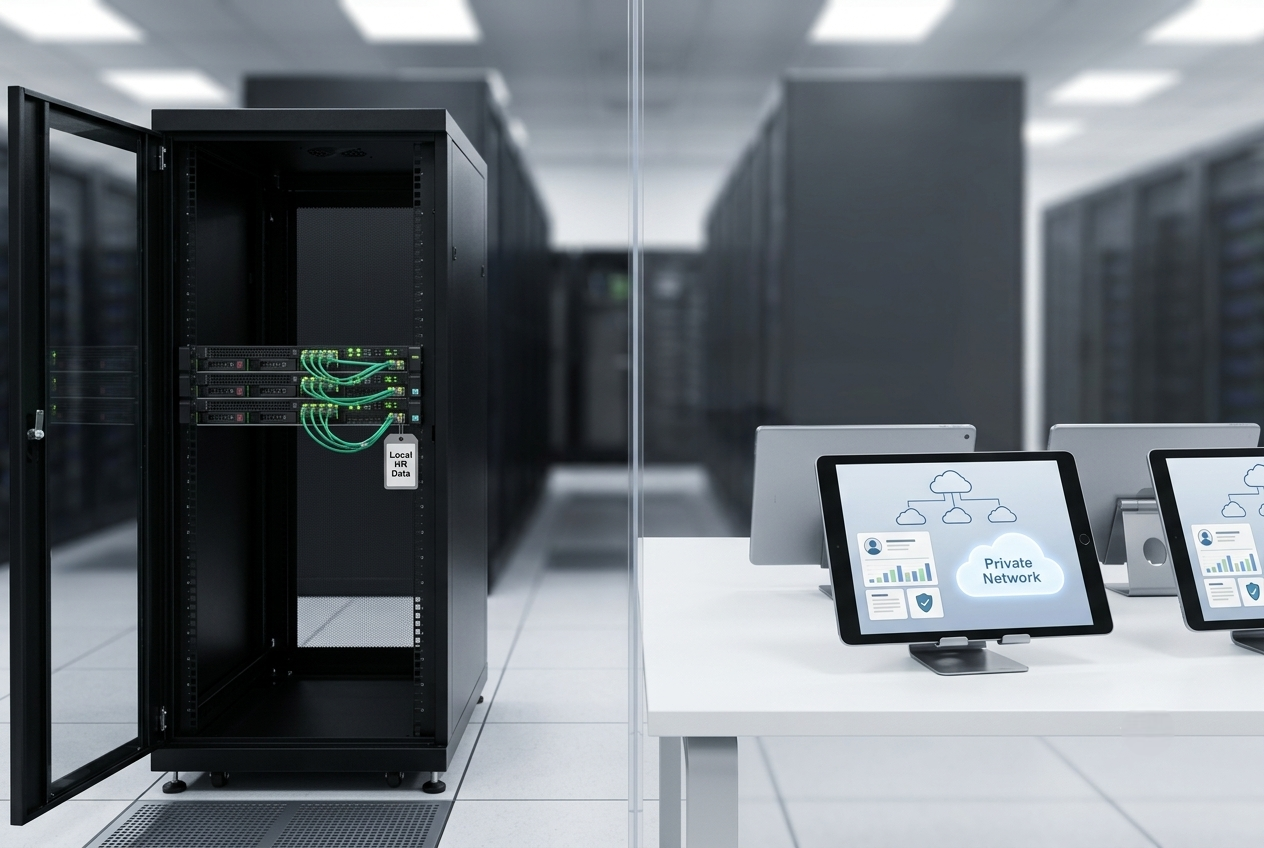
Self-hosting means you are the absolute captain of your own data ship. Your internal IT team is responsible for managing the physical or virtual server where your human resource records live. You own the environment, you lock down the firewall rules, and you decide exactly when software updates occur.
This setup is the ultimate choice for organizations that prioritize strict data sovereignty. Whether you operate within highly regulated industries—such as healthcare, banking, or defense—or maintain a strategic corporate policy that no third-party vendor should handle your operational logs, an on-premise self-hosted HR system provides an airtight perimeter. You aren’t renting shared space in a public multi-tenant cloud; you are building a private fortress for your sensitive personnel data.
If self-hosting is building your own fortress on your own land, private cloud is like leasing an entire dedicated wing in an elite, secure facility. In a private cloud HR environment, the vendor provides an isolated, single-tenant workspace dedicated solely to your enterprise. While the provider manages the underlying infrastructure layers—the physical servers, core bandwidth, and baseline security patches—you still enjoy the absolute data isolation of a standalone system.
This model serves as an ideal middle ground for scaling organizations that want the "hands-off" convenience of cloud delivery without the shared security exposures of multi-tenant cloud systems. It is an enterprise-grade experience that removes the everyday burden of manual server administration while keeping your data tucked safely away from public access.
When finalizing your architecture strategy, the decision typically centers on three operational pillars:
The traditional multi-tenant SaaS model is designed to appear deceptively affordable at first glance, but it often becomes your most expensive long-term line item due to compounding per-user fees. When you invest in an IceHrm Pro perpetual license, you switch to a predictable flat-fee architecture that permanently eliminates this growth tax. Whether your headcount expands from 50 employees to 500, your baseline platform cost remains perfectly stable, maximizing your long-term return on investment.
Self-hosting grants your engineering team the absolute power to tune your environment to precise compliance and speed specifications. You can easily execute your IceHrm system installation behind custom enterprise firewalls or interface it directly with internal corporate databases. However, total control requires specialized oversight. If you prefer the control of standalone infrastructure but lack local systems administrators, leveraging professional technical support and HR services can bridge the operational gap effectively.
For corporate teams that want to completely sidestep server maintenance, utilizing an expert-backed managed hosting service represents the gold standard. With an isolated cloud setup, you gain the supreme data privacy of a private environment without ever needing to touch a command-line interface. It is a highly efficient solution that allows HR managers to stay focused on workforce performance rather than server performance.
The core engineering brilliance of the IceHrm open-source HRMS architecture lies in its total flexibility. We recognize that no two enterprises grow at the exact same pace or share the exact same technical compliance goals.
"The true cost of corporate software isn't just the sticker price on the invoice; it's the cumulative hours your team loses trying to fit their data policy into a rigid system that doesn't align with their deployment goals."
Choosing your target architecture comes down to identifying your organization's technical strengths and data restrictions.
If you possess an active IT department and your corporate compliance standards mandate localized storage, the self-hosted path is the right strategic fit. You trade a brief initial configuration phase for the lifelong benefit of a flat-fee, sovereign ecosystem.
If your priority is high-velocity market execution and you prefer that specialized engineers handle security monitoring and uptime, then an isolated private cloud or managed deployment is your optimal path forward. It lets you tap into enterprise-grade hosting advantages without adding server monitoring tasks to your HR team's daily workload.
The best part of this ecosystem is that you are never locked into a single choice. Because of how the IceHrm platform is designed, your deployment model can seamlessly adapt as your organization grows. You can confidently launch on our managed cloud environment today and smoothly migrate to a self-hosted corporate server tomorrow as your operational needs evolve.