
IceHrm vs Rippling: HR Platform vs Comprehensive HR Suite
Reading Time:
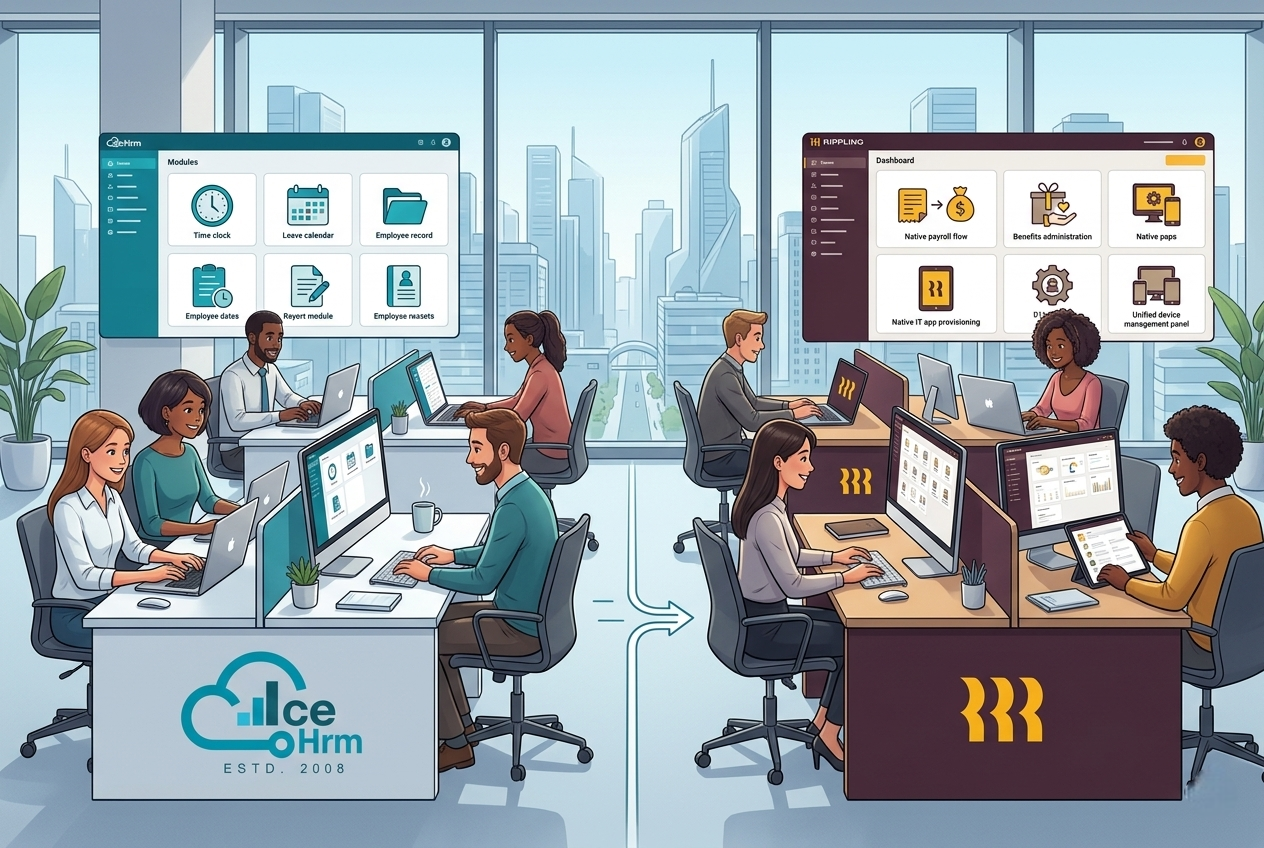
The concept of software consolidation has taken over the corporate world. Modern enterprise tech platforms promise a unified ecosystem where every operational thread—from an employee’s tax withholding to their corporate laptop provisioning and company credit card expenses—is managed within a single dashboard.
Rippling stands as a prime example of this consolidated approach. It has positioned itself not just as human resources software, but as a broad workforce management engine that bundles HR Cloud, IT Cloud, and Finance Cloud into an interconnected system.
For large enterprises, heavily funded technology startups, and corporate groups with complex remote engineering setups, this unified architecture is highly valuable. Rippling’s ability to configure an internal employee record, ship a configured laptop via its identity management tools, and issue an expense account simultaneously is a major administrative asset.
However, this extensive ecosystem introduces a distinct operational paradox for small to mid-market businesses (SMBs), industrial firms, manufacturing operations, and growing regional entities.
If your organization doesn't require complex IT device management, automated single sign-on (SSO) app provisioning, or centralized corporate card tracking, you are still forced to navigate a massive, integrated software suite. This often introduces a high-cost subscription model that penalizes your hiring growth.
This creates an important strategic evaluation for operational leadership: Do you need a wide, all-inclusive software suite that links your IT department and finance tracking directly to your personnel records, or do you require a dedicated, focused human resources platform designed to manage people, time, and leave without the overhead of bundled software layers?
This comparison guide details the fundamental structural differences between Rippling and IceHrm to help you choose the right approach for your team's operational needs and budget.
To understand why companies look for an alternative to Rippling, it is essential to analyze the design of its unified system. Rippling functions as an identity provider (IdP) at its core, using an employee's profile as the foundation to manage access across an organization's digital footprint.
The primary benefit of Rippling is its cross-departmental automation. When an HR coordinator marks a candidate as hired, Rippling’s system can automatically purchase a computer, configure local security policies, create a corporate email account, and map permissions across apps like Slack, Jira, and GitHub based on the worker's role.
Rippling extends its architecture into corporate finance by offering built-in expense management, corporate credit cards, and automated accounts payable workflows. This allows a finance department to monitor total workforce spend, including payroll liabilities, hardware costs, and daily travel expenses, within a single analytics dashboard.
Because Rippling's core value relies on cross-platform automation, its components are highly interdependent. The system operates as a multi-tenant cloud SaaS platform. To unlock its full automation potential, businesses must route significant portions of their IT infrastructure, financial tracking, and internal personnel records through Rippling's proprietary network, resulting in deep vendor dependency.
IceHrm takes a distinctly different approach, focusing on providing a clean, customizable, and dedicated Human Resource Management System (HRMS) without bundling unneeded IT or corporate finance tools.
IceHrm is built specifically for human resource professionals, operational managers, and compliance teams. Instead of devoting development resources to device shipping or expense card clearing, IceHrm focuses completely on optimizing core workforce workflows:
Unlike closed systems that limit your ability to modify how data is handled, IceHrm is built on an open-core architecture. This means your internal development team or implementation partners can access the system's framework to adapt it to your exact requirements.
Organizations can easily choose to buy specific add-on modules to add capabilities like advanced performance evaluations, recruitment workflows, or localized payroll rules cleanly without paying for unneeded features.
The most significant operational difference between these two platforms is how they structure their pricing. This commercial divergence heavily impacts long-term operating budgets as an organization expands its team.
Rippling operates on a multi-tenant SaaS model with a complex, modular pricing structure. The base Unity platform starts at approximately $8 per employee, per month, plus a standard $35 to $40 monthly base fee. However, that baseline cost only covers basic employee directory storage and document collection.
To build a fully functional system, a business must add separate, individual modules. Based on industry transaction data, adding payroll typically introduces an extra $4 to $8 per employee/month, time tracking adds $4 to $6 per employee/month, and benefits administration adds another $4 to $8 per employee/month.
If you expand into their IT device management or Finance Spend modules, the total cost can quickly climb to $15 to $35+ per employee, per month.
Rippling Modular SaaS: Base Platform ($8) + Payroll ($6) + Time Tracking ($5) + Benefits ($5) = $24 per employee/month
If your company employs 200 staff members under this standard configuration, your software expenses can quickly surpass $4,800 every single month, translating to an ongoing operational expense of over $57,000 annually. If you double your headcount due to a successful business expansion, your software bill instantly doubles along with it, creating a linear tax on your hiring growth.
IceHrm removes this variable cost curve by offering an asset-ownership model through the IceHrm Pro Perpetual License.
For a one-time capital investment of $2,499, your business secures absolute ownership of the enterprise source code for an unlimited number of employees, permanently.
"Charging an expanding enterprise more money simply because they hired more workers is essentially a penalty on growth. A perpetual software license treats your core HR directory as a permanent corporate asset, ensuring your software overhead remains entirely flat while your team scales."
By moving your core HR system from an ongoing operational expense (OpEx) to a one-time capital investment (CapEx), you eliminate unpredictable software subscription increases and secure complete long-term budget predictability.
Beyond the financial implications, the two platforms diverge significantly in their underlying technical infrastructure and how they handle sensitive employee information.
Rippling operates exclusively as a multi-tenant cloud platform. Your employee records, corporate banking details, and identification files are housed in a shared cloud environment managed by the vendor. While highly secure, you do not control the underlying database infrastructure, the physical server locations, or the precise security protocols guarding the data layer.
In an environment with tightening global privacy rules and data residency laws, maintaining strict control over where employee Personally Identifiable Information (PII) is stored is a key priority for IT directors and compliance officers.
By leveraging IceHrm's self-hosting capabilities, you can deploy your entire HR platform within your own secure perimeter. You can host the application on physical local servers at your corporate headquarters or within an isolated, private virtual cloud instance on AWS or Azure in your preferred geographic region. Your company retains full ownership of the database, encryption keys, and system logs, ensuring complete data residency compliance.
To accurately evaluate the long-term impact of these two strategies, let’s analyze a three-year cost projection for an expanding mid-market company with 150 employees.
The financial projection highlights a clear reality. For an organization with 150 employees, opting for a dedicated, flat-fee asset model over a complex, bundled suite saves more than $112,000 across three years. This capital remains within your organization to fund strategic business priorities, expand your team, or improve bottom-line profitability.
For many business leaders, the primary hesitation when considering a self-hosted platform is the technical demand placed on internal IT staff. They want the financial predictability and data privacy of a flat-fee license, but they don't want their internal engineers spending time monitoring server uptimes or applying database patches.
This is exactly why IceHrm Managed Hosting serves as an effective middle path.
Through this model, you secure an entirely isolated, private cloud instance dedicated exclusively to your company. The vendor's deployment experts handle all backend maintenance, server security hardening, and continuous automated backups, allowing you to capture the full cost benefits of a perpetual model with the operational simplicity of a fully managed private instance.
To clarify your path forward, consider this operational framework:
Choosing the right platform comes down to a fundamental business decision: are you looking to buy into a broad, multi-departmental software suite, or do you want to invest in a dedicated human resource asset built to fit your precise organizational layout?