IceHrm vs Personio: European HR Software Compared
Reading Time:
Reading Time:
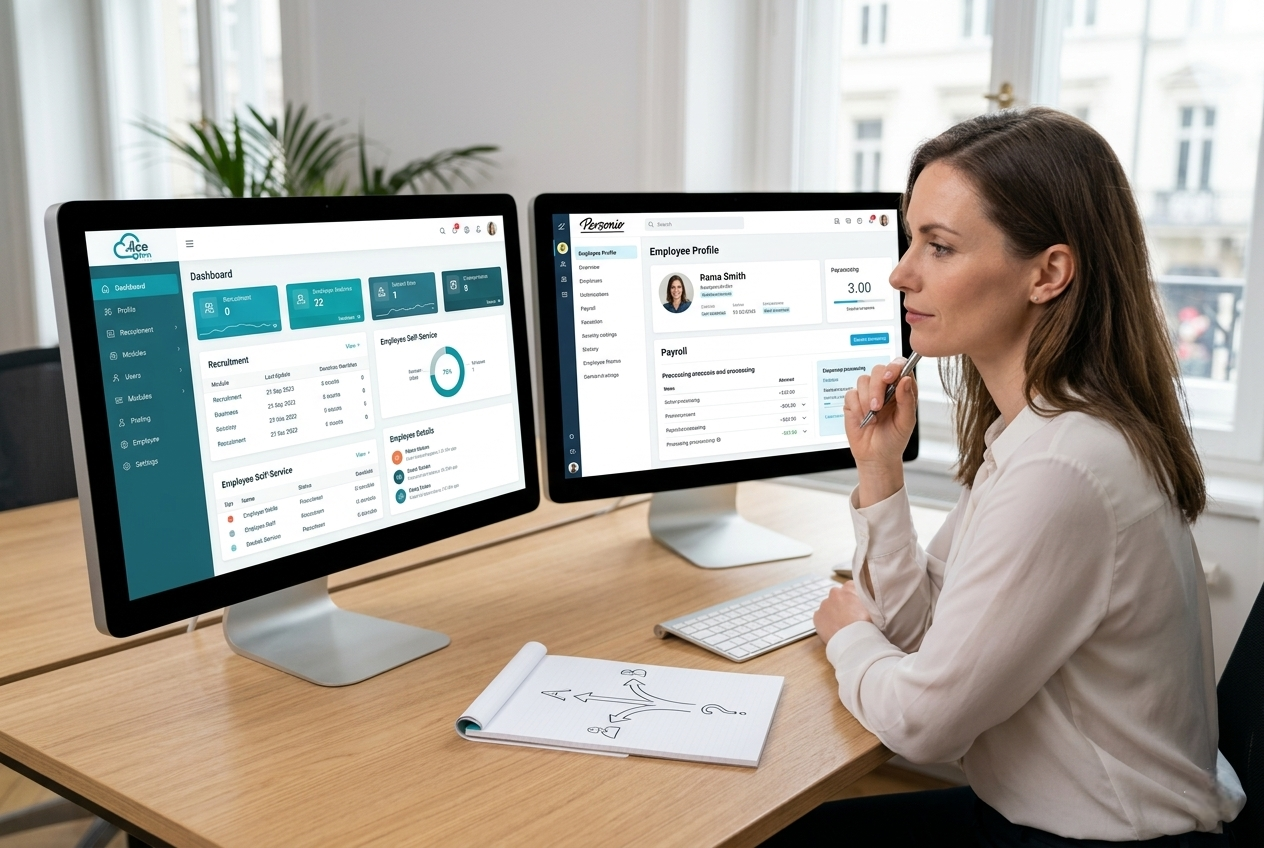
For human resource professionals operating within the European Union, navigating software procurement is uniquely challenging. The strict framework of the GDPR-compliant HR management system guidelines, combined with complex local labor rules across different member states, means generic international software often fails to meet everyday compliance requirements.
In this regional environment, Personio has built an impressive position as an all-in-one HR platform tailored specifically for European small-to-medium enterprises (SMEs). It offers pre-configured workflows designed around continental standards, providing a centralized hub for managing digital personnel files, holiday requests, and preliminary payroll processing.
However, as an organization scales past the initial startup phase, relying entirely on a vendor-managed Software-as-a-Service (SaaS) model can introduce unexpected operational and financial challenges. Many HR directors find themselves locked into rigid, multi-tenant cloud architectures where they have limited control over exactly where their sensitive company records sit.
Furthermore, as your headcount grows, their tier-based subscription packages can scale up dramatically, turning software into an escalating operational expense. If your organization wants to maintain complete control over its data sovereignty, customize its workflows to fit unique local laws, and establish long-term budget predictability, evaluating a capable Personio alternative is a smart strategic move. Let's look closely at how a dedicated standalone platform compares against a regional cloud giant.
The fundamental difference between these two platforms comes down to how they handle data hosting and system control.
Personio runs as a standard multi-tenant cloud application. While they maintain excellent data security standards and leverage secure European data centers—which is a strong point for compliance-minded EU businesses—your employee data still lives on a shared remote infrastructure managed by an external provider. Your sensitive company records, including employee banking details, monthly salary history, and national identity numbers, sit alongside data from thousands of other businesses on the same cloud network.
For security-conscious enterprises, European technology firms, and defense or public sector contractors, this shared model can introduce subtle data sovereignty concerns. True data control requires moving away from shared rental spaces entirely.
   +-----------------------------------------------------------------------+
   |                 THE ARCHITECTURAL SOVEREIGNTY GRAPH                   |
   +-----------------------------------------------------------------------+
   |                                                                       |
   |   [Personio Cloud System] ---> Multi-Tenant Shared Server Cluster     |
   |                                                                       |
   |   [IceHrm Framework]      ---> Private Single-Tenant Hosting          |
   |                           ---> 100% Isolated On-Premise/Cloud DB      |
   |                                                                       |
   +-----------------------------------------------------------------------+
When analyzing Personio vs IceHrm standalone HRMS platform, the standalone path offers an exceptionally secure alternative. Instead of sending your sensitive data to an external vendor's cloud, your technical team can deploy the platform on your own secure private servers or choice of cloud infrastructure via standard self-hosted HR infrastructure pricing layers.
This approach gives your business complete data sovereignty, ensuring your sensitive data never leaves your internal corporate network. It provides your legal team with absolute confidence under GDPR guidelines, as you retain full control over database encryption keys, access logs, and retention schedules.
To make an informed technology decision, it is vital to look closely at the underlying financial models of both approaches based on standard pricing structures.
Personio utilizes a Per-Employee-Per-Month (PEPM) subscription billing structure, where your total software costs scale directly with your headcount. Their base packages typically start from approximately €7.60 per employee each month for core directory tools. However, as your business adds essential everyday tools like advanced recruiting portals, e-signatures, performance tracking modules, or continuous survey apps, those gated add-on fees stack up quickly.
   +-----------------------------------------------------------------------+
   |                  THE HEADCOUNT BILLING ACCUMULATION                   |
   +-----------------------------------------------------------------------+
   |                                                                       |
   |   [75 Active Staff]   --> Core + Add-ons --> Approx. €950 / month     |
   |   [175 Active Staff]  --> Core + Add-ons --> Approx. €2,200 / month   |
   |   [350 Active Staff]  --> Core + Add-ons --> Approx. €4,400 / month   |
   |                                                                       |
   +-----------------------------------------------------------------------+
Under this per-user model, a growing European business with 175 active employees can easily face software costs exceeding €26,000 every single year. This structure creates a financial penalty for expanding your workforce, turning your Human Resource Management System into a rapidly growing operational drain.
Conversely, choosing a focused standalone framework completely disconnects your technology expenses from your total headcount. When you invest in a perpetual commercial license to purchase our flat-fee HR software, your company secures a permanent management engine for a clear, one-time flat fee of $2,499.
   +-----------------------------------------------------------------------+
   |                  FLAT-FEE ONE-TIME INVESTMENT PROFILE                 |
   +-----------------------------------------------------------------------+
   |                                                                       |
   |   Year 1: Asset Core Engine Purchase                    --> $2,499    |
   |   Year 2: Optional Maintenance & System Updates         --> $499      |
   |   Year 3: Optional Maintenance & System Updates         --> $499      |
   |                                                                       |
   |   TOTAL THREE-YEAR OUTLAY: $3,497 (Supports Uncapped User Accounts)   |
   |                                                                       |
   +-----------------------------------------------------------------------+
With an independent standalone system, your total software cost over three full operational years lands at a highly predictable $3,497. This flat rate remains identical whether your active workforce stands at 50 staff members, 250 team members, or over 1,000 personnel across international branches. Your software expense shifts from an unpredictable, recurring bill into a stable, high-value HR expense management software asset that saves your company tens of thousands of dollars long-term.
Every European member state features distinct labor dynamics, ranging from specific shift-allowance rules in Germany to unique collective bargaining agreements (Tarifverträge) across the continent.
"Relying on a standardized cloud application often forces your human resource department to adapt its internal workflows to fit the vendor's rigid software templates, rather than forcing the software to adapt to your actual business policies."
With a rigid, multi-tenant cloud subscription, making deep changes to the core system logic to match unique company workflows is often impossible. With an open, source-available standalone system, your technical team has complete visibility into the codebase.
To align the application with your precise internal workflows or build unique localized reporting tools, you can leverage specialized professional services to safely modify the core system layout. Partnering with experienced infrastructure professionals ensures your platform adapts perfectly to your precise internal workflows, allowing you to connect custom biometric hardware or hook into specific regional banking systems seamlessly.
A modular design ensures your software system scales at the exact pace of your business growth. Instead of dealing with bloated, over-complicated software packages packed with features you don't use, you can choose to buy IceHrm modules individually to assemble the exact toolset your business requires.
   +-----------------------------------------------------------------------+
   |                  MODULAR SOFTWARE SYSTEM SCALING                      |
   +-----------------------------------------------------------------------+
   |                                                                       |
   |   [Core Directory] --> Add [Leave & Attendance Tracker]               |
   |                    --> Integrate Custom Local Payroll Engines         |
   |                    --> Add [Detailed Performance Evaluation Module]   |
   |                                                                       |
   +-----------------------------------------------------------------------+
This flexibility allows your management dashboard to stay exceptionally clean, light, and easy for your team to use. You can activate advanced enterprise features only when your actual business operations require them:
For businesses that want the absolute security of single-tenant data isolation but prefer not to handle server maintenance internally, migrating your setup to a dedicated, single-tenant managed cloud hosting tier offers an excellent middle ground.
Deploying through a secure managed cloud environment provides an isolated container entirely maintained by expert infrastructure teams. This approach combines the hands-off convenience of a traditional SaaS application with the full data security and cost predictability of a flat-fee system, keeping your data safe from unexpected pricing spikes during high-volume hiring seasons.
Choosing the right technology path requires aligning your corporate goals, available technical support, and budget with the appropriate system architecture.
By breaking free from rigid cloud software bundles and moving your employee management workflows to a dedicated standalone platform, you protect your company from unnecessary software costs today while giving your entire organization the perfect foundation to scale smoothly for years to come.
Building an efficient corporate culture requires tools that respect your employees' daily workflows and your company's bottom line, which is achieved best by deploying an independent human resources infrastructure that belongs entirely to your business.