The 7 Best Open-Source HR Software Alternatives in 2026
Reading Time:
In 2026, the promise of "open source" has shifted. It's no longer just about saving a few dollars on licensing; it's about Digital Sovereignty. As global data privacy laws tighten and SaaS "per-employee" pricing becomes a tax on company growth, top-tier organizations are reclaiming their infrastructure.
But not all open-source projects are created equal. Some are thriving ecosystems with weekly security patches, while others are "abandonware" shells—relics of a decade ago that struggle to run on modern servers. If you are looking to purchase a commercial-grade platform without the recurring subscription trap, this guide cuts through the noise to find the 7 best open-source HR software alternatives for your 2026 deployment.
1. IceHrm: The Modern Standard for Sovereignty
If you are looking for the sweet spot between cutting-edge code and enterprise stability, IceHrm is the 2026 frontrunner for companies looking to deploy a self-hosted HR system. While many competitors feel like they were built for the desktop era, IceHrm is natively designed for the private cloud.
Maintenance Status: Extremely Active. With monthly updates and a security-first roadmap, it is one of the few projects fully optimized for PHP 8.x and modern containerized environments.
Target Use Case: Growth-stage companies (100–2,000+ employees) that need to escape the "success tax" of per-user billing.
Deployment: Streamlined for AWS, DigitalOcean, and private VPS. For teams without internal DevOps resources, the IceHrm Cloud managed hosting option provides the privacy of a dedicated instance with SaaS-like convenience.
The Commercial Advantage: The true value of IceHrm lies in its "Sovereign Core." You can start with the free open-source version and, as your company scales, upgrade to the IceHrm Pro Perpetual License for a single flat fee of $2,499. No matter if you hire 50 or 5,000 people, your cost never changes again, making it the most cost-effective HR software with a flat fee on the market.
2. OrangeHRM: The Feature-Rich Veteran
OrangeHRM is arguably the most recognized name in the open-source HR space. It has a massive community and a decade of history.
Maintenance Status: Active. The "Starter" (Open Source) edition receives regular updates, though many of the "flashy" AI features are locked behind their cloud-only Enterprise version.
Target Use Case: Organizations that need a traditional, highly structured HRIS and don't mind a slightly steeper learning curve for the UI.
Complexity: Medium-High. Because it is a massive suite, initial configuration can be daunting without professional services or a dedicated HRIT manager.
3. Frappe HR (ERPNext): The Integrated Giant
Frappe HR is part of the ERPNext ecosystem, making it a favorite for manufacturing and retail companies that need their HR to talk directly to their inventory and accounting.
Maintenance Status: Very Active. It benefits from the massive momentum of the Frappe framework.
Target Use Case: Companies already using ERPNext or those who want an "Everything-in-One" system where HR, Payroll, and Finance live in the same database.
Pricing (2026): 100% free for self-hosting. Managed hosting via Frappe Cloud starts at roughly $16/month for a basic site.
4. Odoo HR (Community Edition): The Modular Choice
Odoo is less of a "software" and more of a "platform." The Community edition is LGPLv3 licensed and serves as the foundation for thousands of custom HR builds.
Maintenance Status: Active. However, be warned: Odoo intentionally leaves "gaps" in the Community edition (like full accounting or mobile app access) to push users toward Enterprise.
Target Use Case: Technical teams who want to build a highly bespoke, modular system.
Deployment: Requires significant PostgreSQL expertise. If you aren't comfortable managing a complex Python-based stack, you'll likely need to budget for Odoo-specific custom development.
5. Sentrifugo: The Comprehensive Legacy
Sentrifugo was once the "all-in-one" king of free software. It famously includes modules—like background checks—that most others charge for.
Maintenance Status: Slow. In 2026, Sentrifugo is showing its age. Community support has dwindled, and security updates are infrequent compared to the velocity of projects like IceHrm.
Target Use Case: Non-profits or micro-businesses with a skilled PHP developer who can manually patch legacy code to keep it running on modern servers.
Deployment: Easy to install, but difficult to secure for the long term.
6. OpenCATS: The Recruitment Specialist
Technically, OpenCATS is an Applicant Tracking System (ATS), but for many small businesses, recruitment is HR.
Maintenance Status: Community-Driven. It is a labor of love by a dedicated group of recruiters and developers.
Target Use Case: Hiring agencies or high-growth startups that need a powerful, open-source pipeline for candidate management.
Deployment: Lightweight and efficient. It can be easily integrated alongside a core HRIS like IceHrm using custom API connectors.
7. WaypointHR: The Simple Database
WaypointHR is the "no-frills" option. It focuses on the most basic element of HR: the employee record.
Maintenance Status: Stable/Minimal. Don't expect a flurry of new features, but the core engine remains functional for simple needs.
Target Use Case: Small companies that just want to get off of spreadsheets and into a structured SQL database without the complexity of a full "Human Capital Management" suite.
Complexity: Very Low. It is one of the easiest to deploy, but it lacks the advanced reporting and automation found in more modern platforms.
Summary: Choosing the Best HRIS Software for Mid-Sized Companies
When choosing an alternative, the true "price" is often hidden in the time your engineering team spends maintaining the system.
For Absolute Freedom and Professional Scaling:IceHrm wins. It is the only platform that offers a complete source code purchase for a flat fee, ending the subscription cycle forever while delivering a top-tier human resource management system.
For Ecosystem Integration:Frappe HR is the choice if you want your HR to live inside your ERP database.
For High-Volume Hiring:OpenCATS is a dedicated specialist that handles the "front end" of candidate acquisition.
"In 2026, the best HR software isn't the one with the most complex feature bloat; it's the one that gives you absolute ownership over your company data."
Moving Beyond the "Free" Version: Total Cost of Ownership
While an open-source core is a powerful starting point, a growing business, enterprise, or international agency often needs a "hardened", production-ready environment.
If you are evaluating these tools for a workforce of 100+ people, you should consider the Total Cost of Ownership (TCO). A "free" tool that requires 10 hours of a senior developer's time every month to patch, update, and fix is actually costing you thousands of dollars in hidden technical debt.
This is why many forward-thinking corporate operations choose a Hybrid Model:
Start with a modern open-source foundation like the IceHrm core framework.
Utilize managed cloud services for instant deployment, data hardening, and hands-free security.
If you are ready to cut operational overhead and eliminate per-employee software taxes permanently, explore how IceHrm scales seamlessly with your workforce.
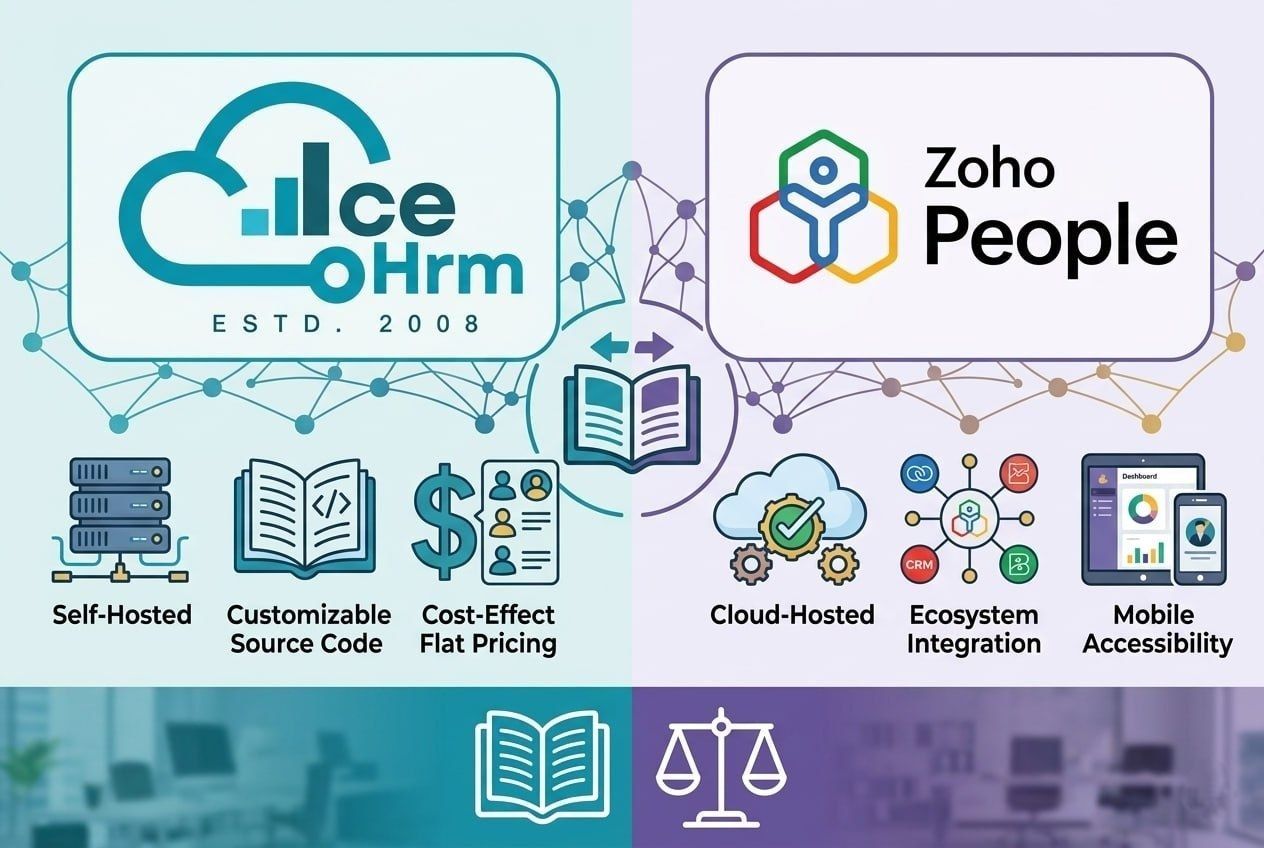
Break free from the "walled garden." While Zoho People offers ecosystem convenience, it comes with a "Success Tax" that scales with your headcount. In 2026, discover why high-growth companies are choosing IceHrm for its flat-fee perpetual licensing, data sovereignty, and limitless flexibility....
Managing a 2,4/7 workforce in hubs like Manila or Bangalore requires more than basic HR tools. This guide explores why BPOs are ditching the "Success Tax" of per-employee SaaS for IceHrm’s flat-fee sovereignty, high-volume recruitment, and shift-ready payroll automation. Stop paying for every seat....