
Best HR Software Alternatives Without Per-Employee Pricing
Reading Time:

In the fast-paced world of 2026, growth is usually a cause for celebration—until your HR software bill arrives. For most companies, the standard SaaS model operates on a "Success Tax": as you hire more people to drive your business forward, your software provider punishes you with a higher monthly invoice.
This is the hidden trap of per-employee-per-month (PEPM) pricing. While it feels affordable when you have 10 employees, it becomes a scaling nightmare when you hit 100 or 1,000. If you are tired of watching your overhead skyrocket every time you grow your team, it’s time to look at HR software for unlimited employees with a predictable flat fee.
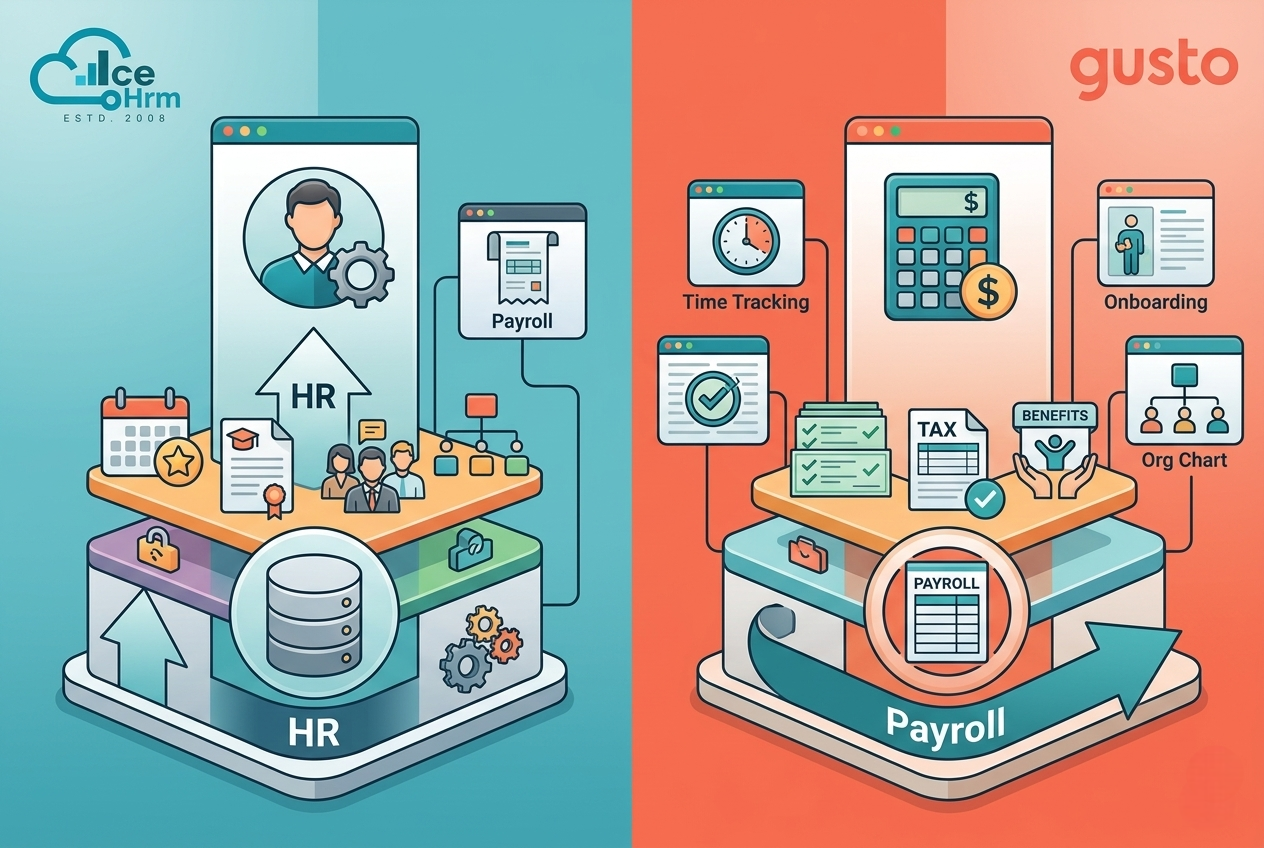
Most popular platforms like BambooHR, Rippling, and Gusto rely on the PEPM model. In 2026, the average cost for a mid-tier HRIS ranges from $8 to $25 per employee, per month.
Let’s look at the math for a company growing from 50 to 250 employees:
For that same $45,000, you aren't necessarily getting "more" software—you are simply paying more to store the same types of data for a larger group of people. This is why forward-thinking CTOs and HR Directors are moving toward on-premise or source-available solutions that offer a flat-fee perpetual license.
IceHrm was built specifically to solve the "Success Tax" problem. Instead of charging you for every new hire, IceHrm offers a high-performance, Source-Available HRIS that you can own outright.
The Financial Logic:
When you purchase IceHrmPro, you pay a flat fee of $2,499 for the first year. This covers unlimited employees.
For a 250-person company, choosing IceHrm instead of a traditional SaaS provider could save you over $40,000 in your first year alone. These savings can be reinvested into employee development, better benefits, or specialized professional services to customize your platform.
If you are a massive global enterprise, you might be considering the "big guns" like Workday or SAP SuccessFactors. While these platforms rarely offer a "simple" flat fee, they do offer Enterprise License Agreements (ELAs).
Workday Tiers
Workday doesn't have a public "unlimited" price, but for companies with 5,000+ employees, they move into negotiated contract tiers. However, be prepared for the "Total Cost of Ownership" (TCO). A mid-market Workday implementation (1,000–5,000 employees) can cost between $100,000 and $200,000 in subscription fees alone, with implementation often doubling that cost.
Legacy On-Premise Software
Traditional enterprise software (think Oracle PeopleSoft or older SAP R/3 installs) allowed for on-premise deployments with perpetual licenses. However, these are often built on aging architectures that require a small army of IT consultants to maintain.
The IceHrm Advantage here: You get the modern, modular architecture of a cloud-native app with the "one-and-done" pricing of a legacy perpetual license.
When you pay per employee to a SaaS vendor, you are renting space in their "black box." When you choose a flat-fee, self-hosted system, you gain Data Sovereignty.
If you don't want to manage the servers yourself, you can still opt for managed hosting, where the infrastructure is handled for you while the software license remains flat-fee.
A lower price shouldn't mean fewer features. When looking for a flat-fee HRIS, ensure it includes these core modules:
In 2026, the most successful companies are those that control their infrastructure costs. Paying a subscription tax on your headcount is no longer the only way to get high-quality HR software.
By switching to a platform with unlimited employee support and a predictable flat fee, you stop viewing your team as a "cost per seat" and start seeing them as the engine of your growth.