The 7 Best Open-Source HR Software Alternatives in 2026
Reading Time:
In 2026, the promise of "open source" has shifted. It’s no longer just about saving a few dollars on licensing; it’s about Digital Sovereignty. As global data privacy laws tighten and SaaS "per-employee" pricing becomes a tax on company growth, top-tier organizations are reclaiming their infrastructure.
But not all open-source projects are created equal. Some are thriving ecosystems with weekly security patches, while others are "abandonware" shells—relics of a decade ago that struggle to run on modern servers. This guide cuts through the noise to find the 7 best open-source HR software alternatives for your 2026 deployment.
1. IceHrm: The Modern Standard for Sovereignty
If you are looking for the sweet spot between "cutting-edge code" and "enterprise stability," IceHrm is the 2026 frontrunner. While many competitors feel like they were built for the desktop era, IceHrm is natively designed for the private cloud.
Maintenance Status: Extremely Active. With monthly updates and a security-first roadmap, it is one of the few projects fully optimized for PHP 8.x and modern containerized environments.
Target Use Case: Growth-stage companies (100–2,000+ employees) that need to escape the "success tax" of per-user billing.
Deployment: Streamlined for AWS, DigitalOcean, and private VPS. For teams without DevOps, the managed hosting option provides the privacy of a dedicated instance with SaaS-like convenience.
"The true value of IceHrm lies in its 'Sovereign Core.' You can start with the free version and, as you scale, move to IceHrmPro for a flat fee of $2,499. No matter if you hire 50 or 5,000 people, your cost never changes again."
2. OrangeHRM: The Feature-Rich Veteran
OrangeHRM is arguably the most recognized name in the open-source HR space. It has a massive community and a decade of history.
Maintenance Status: Active. The "Starter" (Open Source) edition receives regular updates, though many of the "flashy" AI features are locked behind their cloud-only Enterprise version.
Target Use Case: Organizations that need a traditional, highly structured HRIS and don't mind a slightly steeper learning curve for the UI.
Complexity: Medium-High. Because it is a massive suite, initial configuration can be daunting without professional services or a dedicated HRIT manager.
3. Frappe HR (ERPNext): The Integrated Giant
Frappe HR is part of the ERPNext ecosystem, making it a favorite for manufacturing and retail companies that need their HR to talk directly to their inventory and accounting.
Maintenance Status: Very Active. It benefits from the massive momentum of the Frappe framework.
Target Use Case: Companies already using ERPNext or those who want an "Everything-in-One" system where HR, Payroll, and Finance live in the same database.
Pricing (2026): 100% free for self-hosting. Managed hosting via Frappe Cloud starts at roughly $16/month for a basic site.
4. Odoo HR (Community Edition): The Modular Choice
Odoo is less of a "software" and more of a "platform." The Community edition is LGPLv3 licensed and serves as the foundation for thousands of custom HR builds.
Maintenance Status: Active. However, be warned: Odoo intentionally leaves "gaps" in the Community edition (like full accounting or mobile app access) to push users toward Enterprise.
Target Use Case: Technical teams who want to build a highly bespoke, modular system.
Deployment: Requires significant PostgreSQL expertise. If you aren't comfortable managing a complex Python-based stack, you’ll likely need to budget for Odoo-specific custom development.
5. Sentrifugo: The Comprehensive Legacy
Sentrifugo was once the "all-in-one" king of free software. It famously includes modules—like background checks—that most others charge for.
Maintenance Status: Slow. In 2026, Sentrifugo is showing its age. Community support has dwindled, and security updates are infrequent compared to the velocity of projects like IceHrm.
Target Use Case: Non-profits or micro-businesses with a skilled PHP developer who can manually patch legacy code to keep it running on modern servers.
Deployment: Easy to install, but difficult to secure for the long term.
6. OpenCATS: The Recruitment Specialist
Technically, OpenCATS is an Applicant Tracking System (ATS), but for many small businesses, recruitment is HR.
Maintenance Status: Community-Driven. It is a labor of love by a dedicated group of recruiters and developers.
Target Use Case: Hiring agencies or high-growth startups that need a powerful, open-source pipeline for candidate management.
Deployment: Lightweight and efficient. It can be easily integrated alongside a core HRIS like IceHrm using custom API connectors.
7. WaypointHR: The Simple Database
WaypointHR is the "no-frills" option. It focuses on the most basic element of HR: the employee record.
Maintenance Status: Stable/Minimal. Don't expect a flurry of new features, but the core engine remains functional for simple needs.
Target Use Case: Small companies that just want to get off of spreadsheets and into a structured SQL database without the complexity of a full "Human Capital Management" suite.
Complexity: Very Low. It is one of the easiest to deploy, but it lacks the advanced reporting and automation found in more modern platforms.
Summary: Comparing the 2026 Landscape
When choosing an alternative, the "price" is often hidden in the time you spend maintaining the system.
For Absolute Freedom and Professional Scaling:IceHrm wins. Its Pro version is the only one that offers a "full source code" purchase for a flat fee, ending the subscription cycle forever.
For Ecosystem Integration:Frappe HR is the choice if you want your HR to live inside your ERP.
For High-Volume Hiring:OpenCATS is a dedicated specialist that handles the "front end" of HR better than most general suites.
"In 2026, the best HR software isn't the one with the most features; it's the one that gives you the most control over your own data."
Moving Beyond the "Free" Version
While open source is a powerful starting point, a growing BPO or enterprise often needs a "hardened" version for production.
If you are evaluating these tools for a workforce of 100+ people, you should consider the Total Cost of Ownership (TCO). A "free" tool that requires 10 hours of a senior developer's time every month to patch is actually costing you thousands of dollars in hidden salary.
This is why many 2026 leaders choose a Hybrid Model:
Start with the Open Source Core of a modern project like IceHrm.
Purchase specific extensions for Payroll or Performance only when the business grows.
Utilize Professional Services for a one-time migration and hardening, ensuring the system is secure for the next decade.
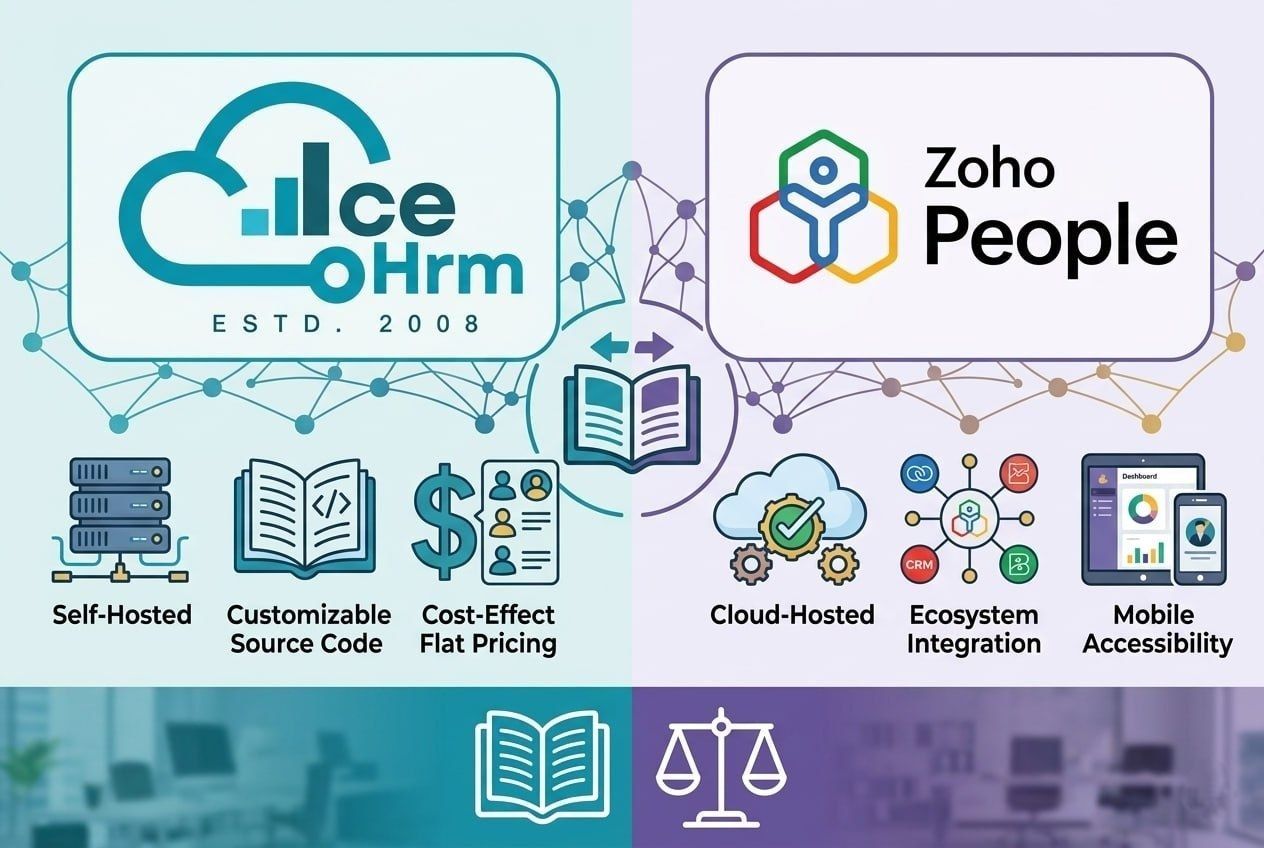
Break free from the "walled garden." While Zoho People offers ecosystem convenience, it comes with a "Success Tax" that scales with your headcount. In 2026, discover why high-growth companies are choosing IceHrm for its flat-fee perpetual licensing, data sovereignty, and limitless flexibility....
Managing a 2,4/7 workforce in hubs like Manila or Bangalore requires more than basic HR tools. This guide explores why BPOs are ditching the "Success Tax" of per-employee SaaS for IceHrm’s flat-fee sovereignty, high-volume recruitment, and shift-ready payroll automation. Stop paying for every seat....