
HR Software for Retail Chains: A Complete Comparison
Reading Time:
Managing a human resources department for a single corporate office is a relatively predictable exercise. You track salaried professionals, process standardized monthly payrolls, and handle standard performance reviews.
However, when you move into the retail sector, that predictable model collapses completely.
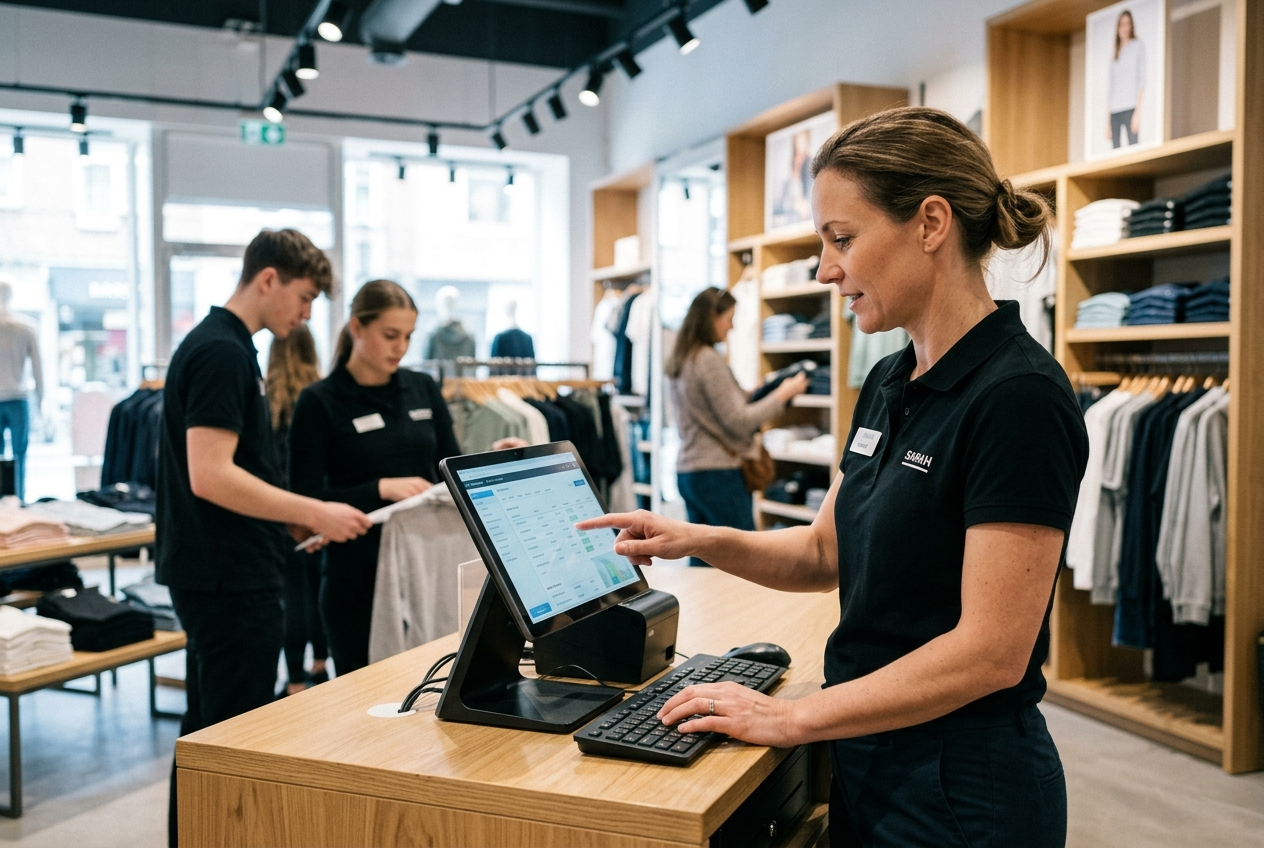
Operating a multi-location storefront network, a regional supermarket chain, or a fast-growing apparel franchise introduces a complex set of operational friction points. You are no longer managing a static corporate directory; you are dealing with a dynamic workforce spread across diverse storefront networks. You have to manage highly complex shift-scheduling rotations, oversee hourly part-time and seasonal staff, coordinate split-shifts, and mitigate a constant, industry-wide challenge: exceptionally high employee turnover.
If a retail store manager spends ten hours a week manually wrangling Excel spreadsheets to fix shift conflicts or chasing text messages to cover an unexpected weekend absence, they are not on the showroom floor driving sales, monitoring inventory, or training customer-facing teams.
Furthermore, if your central database does not allow regional field managers to handle local onboarding securely, your recruitment funnel bottlenecks, causing understaffed storefronts and lost retail revenue.
To operate efficiently, retail brands require a dedicated Human Resource Management System (HRMS) built to manage multi-location operations, high-volume seasonal hiring, geofenced mobile time clocking, and complex shift tracking.
This comprehensive guide analyzes the top options for retail chain HR management, evaluating multi-tenant scheduling engines, retail-focused suites, and localized flat-fee platforms to help you select the ideal framework for your brick-and-mortar operations.
To keep a multi-location retail chain running smoothly, your core software system must solve four distinct operational challenges right out of the box.
A corporate retail framework must balance local store management with centralized corporate oversight. A store manager in Store A should be able to view their direct team's availability, approve shift-swaps, and log local disciplinary records without seeing the financial details or employee records of Store B or the executive headquarters.
Your HR platform must feature advanced, role-based permission tiers that isolate localized store data while providing corporate human resources directors with a bird's-eye view of your entire retail footprint.
                  +-----------------------------------+
                  |      CENTRAL HR ADMINISTRATION    |
                  | (Global Overview & Master Payroll)|
                  +-----------------------------------+
                                    |
            +-----------------------+-----------------------+
            |                                               |
            v                                               v
+-----------------------+                       +-----------------------+
|    STORE FRONT A      |                       |    STORE FRONT B      |
|  (Manager & Staff)    |                       |  (Manager & Staff)    |
| Isolated Shift Data   |                       | Isolated Shift Data   |
+-----------------------+                       +-----------------------+
With retail employee turnover rates routinely exceeding 60% annually, your human resources team is constantly recruiting, background-checking, and onboarding new talent.
If your hiring process requires sending physical paperwork back and forth to your central corporate office, storefronts will remain chronically understaffed. The system must feature paperless onboarding, digital document signing, and instant mobile profile creation to get a new associate onto the sales floor within 24 hours.
Retail demands variable scheduling engines that match store hours with consumer demand patterns. The platform must allow managers to design complex weekly templates, handle split shifts, flag potential compliance or overtime violations before publishing, and distribute schedules directly to employees' mobile devices instantly.
Paper timesheets and physical punch-cards are highly vulnerable to manual entry errors and time theft ("buddy punching"). A retail-ready system must utilize mobile-based or tablet-based time clocks equipped with precise GPS geofencing or biometric verification. This ensures that an hourly associate can only clock into their shift when they are physically inside their assigned retail storefront.
Several prominent multi-tenant cloud platforms focus primarily on solving shift scheduling and mobile time tracking for front-line hourly teams.
Deputy has established itself as a leading choice for shift-heavy businesses requiring rapid schedule distribution and labor-cost forecasting.
The Retail Advantage: Deputy's platform features real-time demand forecasting. By integrating directly with your retail Point of Sale (POS) system, it predicts required labor headcounts based on historical sales trends, preventing managers from over-scheduling or under-scheduling staff. Its mobile app allows employees to claim open shifts, drop schedules, or log break times with a swipe. G2+ 1
The Cost Architecture: Deputy operates on a per-user, multi-tenant subscription framework. Their Scheduling or Time & Attendance standalone modules start at $5.00 to $6.50 per user, per month. To unlock their full capability, the Pro tier costs $9.00 per user, per month, and adding basic onboarding or HR records requires their HR Add-On for an extra $2.00 per user, per month. Software Advice+ 2
When I Work targets small to mid-market retail businesses that want a simple tool to eliminate chaotic group texts and manual paper scheduling. G2
While primarily built for the restaurant industry, 7shifts is frequently deployed by fast-casual retail lines, gas station networks, and specialized storefronts that combine inventory sales with food services.
For mid-sized retail chains, department store networks, franchise groups, and multi-branch operations, IceHrm offers a powerful alternative to traditional subscription systems.
IceHrm delivers all the essential tools required to run front-line hourly operations, but packages them within an open, highly secure, and flat-fee commercial model.
[ Traditional SaaS Cloud ] ----> Monthly Per-Employee Costs Rise with Turnover
[ IceHrm Pro Framework ]   ----> Flat-Fee License covers Unlimited Employees
The primary advantage of IceHrm for the retail sector is its unique commercial architecture. While subscription platforms penalize your business for high turnover by charging for every worker profile created, the IceHrm Pro Perpetual License provides absolute ownership of the enterprise source code for a single, one-time investment of $2,499.
You can onboard unlimited part-time workers, scale your workforce for peak holiday shopping seasons, and maintain a comprehensive historical archive of former employees without experiencing variable adjustments to your monthly software bill.
IceHrm is designed specifically to handle complex, multi-branch corporate structures out of the box.
Using its robust role-based permissions engine, your corporate IT administrators can assign distinct, restricted access clearings to local store managers. A manager at Store Location A can independently build schedules, approve local timesheets, and run branch reports, but they are securely restricted from viewing employee records or editing configurations for Store Location B or the regional corporate headquarters.
Hourly employees can access an intuitive self-service portal via their smartphones to log hours, request time-off, or review their upcoming shift schedules. Unrubble
Furthermore, IceHrm features a built-in asset management module. This allows corporate operations teams to log exactly which store keys, mobile POS tablets, or security badges have been assigned to specific store workers, streamlining your loss-prevention and inventory controls.
Rather than overwhelming your store managers with a cluttered system full of unneeded features, IceHrm's flexible, open-core codebase allows your business to activate tools precisely when needed. Retail groups can choose to buy specific add-on modules like advanced performance evaluations, recruitment tracking, or specialized document storage only as their operational goals expand.
"A perpetual software architecture shifts an organization's HR framework from a continuous monthly operating expense into a stable corporate asset. It provides multi-location retail chains with the data control and long-term budget predictability required to scale their store networks securely."
To understand the financial implications of these strategies, let’s analyze a Total Cost of Ownership (TCO) projection for an expanding regional retail chain with 250 active employees across 12 distinct storefront locations over a standard three-year horizon.
The long-term financial difference is undeniable. For a retail chain running 250 active employees, choosing an asset-ownership model like IceHrm Pro saves over $25,000 compared to location-based platforms, and more than $91,000 compared to standard per-user cloud subscriptions across three years. This capital can be directly reinvested into expanding your product inventory, launching new storefront marketing campaigns, or increasing front-line associate wages to reduce store turnover.
For many retail operations directors, the primary hesitation when considering a self-hosted platform is the management demand on their internal IT department. They want the financial savings and data control of a flat-fee architecture, but they don't want their small internal technical team managing server patches, monitoring cloud firewalls, or running manual database backups.
This is exactly why IceHrm Managed Hosting serves as an effective middle path.
Through this model, you secure an entirely isolated, private cloud instance dedicated exclusively to your company. The vendor's deployment experts handle all backend maintenance, server security hardening, and continuous automated backups. This allows your business to capture the complete cost benefits and data privacy of a perpetual license model, while entirely removing server administration demands from your internal IT teams.
Selecting the right HR software for your retail network involves matching your technical capabilities with your financial goals:
Choose When I Work if: You are a small, single-location retail business with under 30 employees, have no access to IT support, and simply need an easy mobile scheduling tool to replace manual paper tracking. Software Finder
Are you building an enterprise ecosystem that your retail chain genuinely owns, or are you comfortable continuing to rent your employee infrastructure year after year?