Best HR Software for Companies Without an HR Department
Reading Time:
Reading Time:

In the high-stakes environment of business, a solo founder or office manager is often a "department of one." You act as the CEO, the lead salesperson, and—by sheer necessity—the Head of Human Resources. But here is the reality: every minute you spend wrestling with a complex leave approval workflow or manually calculating a prorated salary is a minute taken away from scaling your enterprise.
For companies operating without a dedicated HR department, the goal isn't just to find "software." You need a digital assistant that automates compliance, handles time-consuming paperwork, and empowers your employees to help themselves through intuitive self-service features.
Most traditional HR software is built explicitly for HR professionals. It is filled with dense industry jargon like "EEO-1 reporting," "vesting schedules," and "HCI metrics." To an enterprise HR Director, these features are essential. To a business founder, they are an administrative headache.
When you manage a growing team without a dedicated HR department, you face three primary structural risks:
The software market offers two distinct operational philosophies to solve this dilemma: "Convenience at a Premium" (expensive SaaS platforms) and "Control with Financial Freedom" (Self-Hosted/Open-Source infrastructure).
Gusto has maintained its position as a common recommendation for US-based startups. Its core philosophy is simple: HR and payroll processing should be invisible.
If you can navigate a modern online banking app, you can comfortably run Gusto. It utilizes clear, humanized language and sends automatic notifications when a tax form requires a digital signature. For a busy founder, the biggest operational win is the automated Employee Self-Onboarding feature. You simply enter a new hire's email address and salary, and Gusto handles the rest—tax forms, I-9 compliance, and direct deposit setups.
While Gusto's pricing is transparent, it scales linearly and adds up rapidly as your workforce expands:
Gusto operates like hiring a part-time administrator who never sleeps. You pay a premium for the convenience of never having to think about regional payroll tax compliance again.
Gusto is primarily a US-centric platform. If you manage an international remote team, hire global contractors, or require deep workflow customization beyond their standard templates, you will hit a functional wall quickly.
While Gusto leads on automated payroll, BambooHR Core is designed for companies that want to feel established and structured without hiring a full-scale HR team. It focuses heavily on the employee experience—the human side of HR management.
BambooHR is well-known for its clean, white-label visual layout. It is an excellent choice for office managers who need to track metrics beyond standard paychecks. The system handles performance notes, training records, and company-wide announcements with a level of visual polish that makes a 15-person startup look like a 500-person enterprise.
BambooHR has introduced more accessible tiers, but it maintains a premium software cost model:
Payroll processing is treated as an optional add-on within BambooHR, which can result in a fragmented system experience if you do not use their specific partners. For a solo founder, managing two separate unlinked systems (HR tracking + separate Payroll software) can often defeat the purpose of simplifying your administrative workload.
For budget-conscious founders, growing agencies, or global business owners, IceHrm's open-source HR software offers a strategic operational path that neither Gusto nor BambooHR can match: a professional-grade HRIS with zero mandatory monthly subscription fees.
IceHrm provides a rock-solid, highly functional central dashboard dedicated to comprehensive employee record management, automated leave tracking, and digital timesheets. It eliminates unnecessary aesthetic clutter to focus entirely on core business utility. It is designed specifically for the cost-conscious business owner who wants a stable system they can deploy once and own forever.
The true value of an open-source HR platform isn't merely the affordable price tag; it is the complete elimination of a subscription leash. You maintain absolute ownership of your corporate data, control the underlying code, and never have to worry about a software vendor raising your monthly rates.
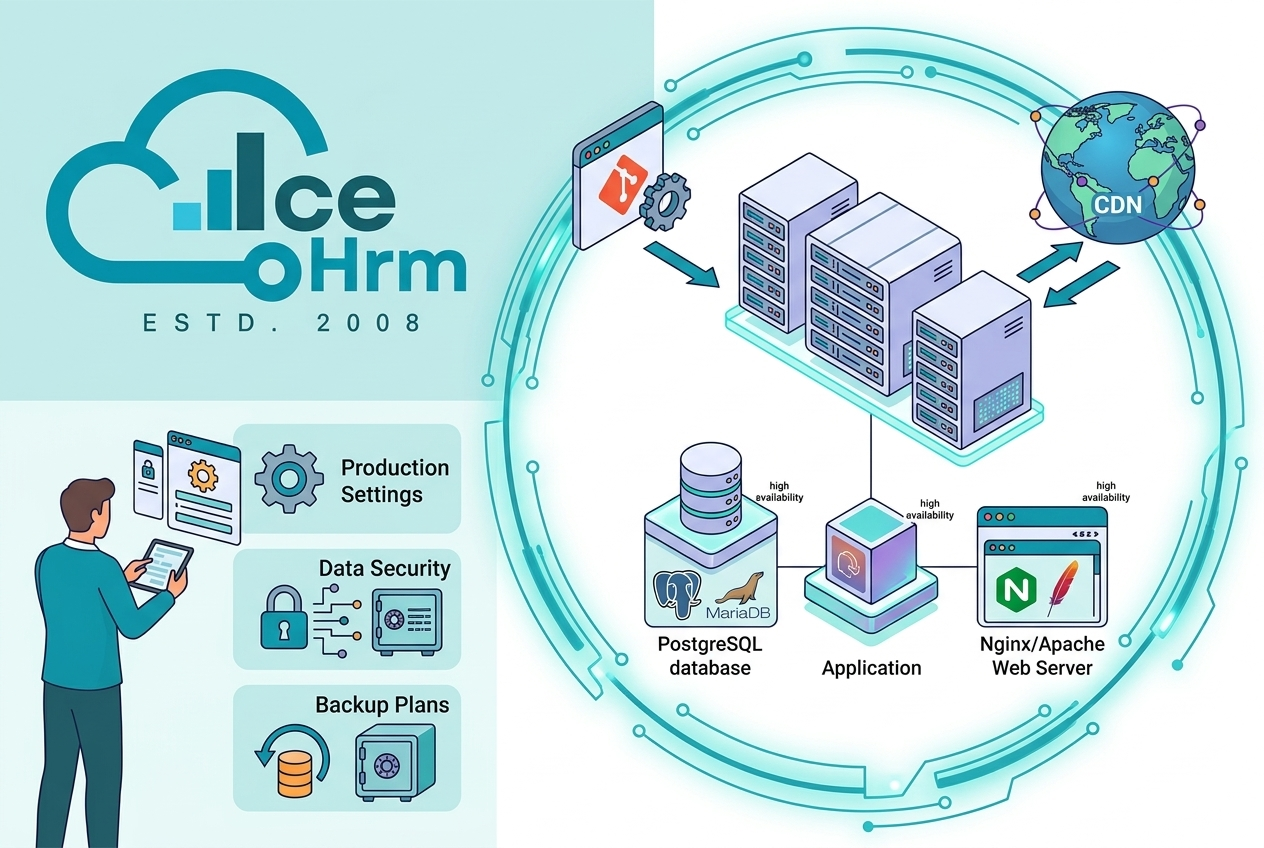
IceHrm requires a brief, one-time initial configuration. If your company lacks internal IT resources, you can completely bypass the technical setup and leverage our white-glove HRMS setup and deployment services for a seamless, hassle-free configuration.
Choosing between these three systems isn't about determining which platform is universally "better"—it is about identifying which administrative model aligns with your business goals.
When you are the one personally managing the software, specific system functionalities move from "optional features" to daily necessities.
The most effective piece of HR software is the one your employees can navigate independently without knocking on your office door to ask questions.
In a fast-scaling startup, your software requirements change every six months. Gusto and BambooHR force you into a rigid, all-or-nothing software suite. IceHrm utilizes a flexible, modular architecture. You can begin tracking basic employee data entirely for free, and choose to purchase advanced, dedicated add-on modules only when your company expands to a size that genuinely requires them.
Data privacy is a core corporate competitive advantage. When using standard SaaS platforms, your proprietary company documentation and employee records live entirely on their third-party servers. If you choose to stop paying your monthly subscription, you lose live access to your system. With a self-hosted installation of IceHrm, you can deploy the platform on your own private infrastructure or utilize our secure managed cloud HR software hosting. Your historical data remains yours permanently.
Many business owners wait too long to implement formal HR systems, holding out until they hit 15 or 20 employees and find themselves trapped in a massive, disorganized spreadsheet mess. The secret to clean scaling is to implement a system when you hit your first 3 to 5 hires.
By starting early with a flexible platform like IceHrm, you build the operational habits of a professional organization from day one. You establish transparent leave policies, archive employee contracts securely, and create a single, immutable source of truth for your corporate data. As your enterprise scales, you won't need to endure a painful data migration to a new platform; you simply scale your existing workspace alongside your success.