Self-Hosted vs Cloud HR Software: Which Is Right for You?
Reading Time:
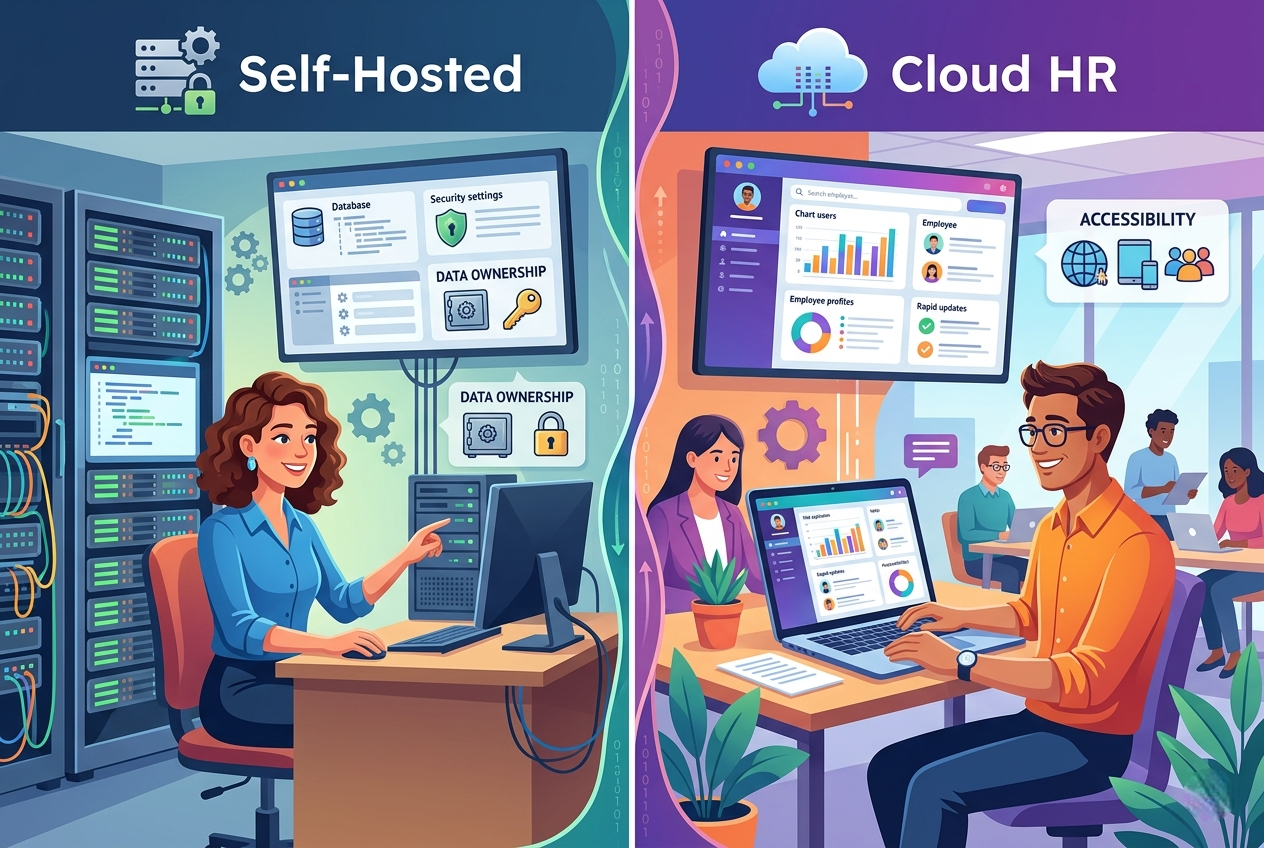
The choice between self-hosted and cloud-based HR software is no longer just a technical debate; in 2026, it is a high-stakes decision about Digital Sovereignty, Financial Strategy, and Data Control.
As we navigate an era of tightening privacy laws like the Australian Privacy Act amendments and GDPR, and the increasing "Success Tax" of per-employee SaaS subscriptions, businesses are at a crossroads. Should you rent your infrastructure from a global provider for convenience, or build your own sovereign vault to ensure your employee data stays exactly where you want it?
This guide provides a comprehensive decision framework to help you determine which model fits your company’s DNA in 2026.
1. The Core Philosophy: Control vs. Convenience
The Self-Hosted (On-Premise) Model
Self-hosted HR software, like the IceHrm Pro Perpetual License, is for organizations that view their HRIS as a long-term capital asset. You install the software on your own servers—either physical hardware in your office or a private cloud instance on AWS, Azure, or Google Cloud.
Primary Benefit: Total sovereignty. You own the code, the database, and the server. No third-party vendor has "backdoor" access to your sensitive employee PII (Personally Identifiable Information).
The IT Requirement: You need someone who knows how to manage a Linux server and a MySQL database. While Professional Services can help with setup, the day-to-day oversight is yours.
The Cloud (SaaS) Model
Cloud HRIS is "rented" software. Platforms like BambooHR, Employment Hero, or Rippling host your data on their shared servers and charge you a monthly fee.
Primary Benefit: Speed and simplicity. You can sign up with a credit card and have an employee directory running in five minutes.
The Trade-off: You are subject to the vendor’s security protocols, their update schedule, and, most importantly, their price hikes.
"In 2026, convenience is a commodity, but control is a competitive advantage. If your industry requires air-gapped security or extreme data privacy, self-hosting isn't just an option—it’s a requirement."
2. The Decision Framework: 5 Key Pillars
To choose the right path, evaluate your company against these five pillars of HR operations.
I. Data Control and Sovereignty
In the UAE, Australia, and the EU, data residency laws are becoming stricter.
Self-Hosted: You decide the geographical location of your data. If you need your records to stay in Sydney or Dubai to meet local laws, Self-Hosting on a local server is the only way to be 100% certain.
Cloud: Your data often lives in a "region" (like US-East). While major vendors offer regional hosting, you are still trusting their multi-tenant architecture, where your data sits on the same server as thousands of other companies.
II. Compliance and Regulation
Self-Hosted: Ideal for "High-Compliance" industries (Defense, Finance, Healthcare). You can apply custom security patches and hardened firewall rules that a generic SaaS platform won't allow.
Cloud: Better for "High-Change" small businesses. If you are a 20-person team in the US and need to stay compliant with 50 different state tax laws, a SaaS tool like Gusto is better because they handle the legal updates automatically.
III. IT Infrastructure and Expertise
Self-Hosted: Requires a DevOps mindset. You must manage backups, SSL certificates, and server hardening. However, many firms use Managed Hosting to bridge the gap—getting a private instance that is maintained by the software vendor’s experts.
Cloud: Requires zero IT. The vendor handles everything from server uptime to security patches.
IV. Scalability and the "Success Tax"
Self-Hosted: Scales "horizontally." You pay for the software once (e.g., IceHrmPro for $2,499) and your costs remain flat whether you have 100 or 10,000 employees.
Cloud: Scales "linearly" (The Success Tax). Most SaaS tools charge $8–$30 per employee, per month. As you hire more people, your software bill grows, penalizing your success.
V. Customization Depth
Self-Hosted: Total flexibility. Because you have access to the database and specific modules, you can build custom integrations with your internal legacy systems that a standard Cloud API would block.
Cloud: Configurable, but not customizable. You can change colors and add custom fields, but you cannot change the underlying logic of how the system works.
3. The 2026 Cost Reality: A Comparative Look
To understand the true cost, we have to look at the Total Cost of Ownership (TCO) over a three-year horizon for a 250-employee company.
Cloud HRIS (e.g., BambooHR or Rippling):
Average Cost: $15 per employee / month.
Year 1: $45,000 (Subscription) + $5,000 (Implementation) = $50,000
"The financial math is undeniable. For a mid-sized company, self-hosting can save over $120,000 every three years. That is money that could be spent on employee wellness, better salaries, or R&D."
4. When Cloud is Actually Better
We are advocates for Self-Hosting, but we aren't ideologues. There are three specific scenarios where Cloud SaaS is the objectively better choice in 2026:
Micro-Businesses (Under 25 Employees): If you are a very small team, the time you spend managing a server is worth more than the $100/month you’d pay for a SaaS tool.
Zero Technical Capacity: If your company does not have a single IT person (internal or external) and you don't want to use Managed Hosting, don't self-host. HR data is too sensitive to leave on an unpatched server.
US-Only Payroll with Tax Filing: If your only requirement is filing US state and federal taxes for a small team, the "all-in-one" convenience of a cloud payroll provider is hard to beat.
5. The "Middle Path": Managed Private Hosting
For many Australian and Gulf-based firms in 2026, the choice isn't binary. They want the security and flat-fee pricing of a self-hosted system, but the zero-maintenance experience of the cloud.
A team of experts who handle the backups, security patches, and server uptime.
This model effectively eliminates the "IT requirement" hurdle of self-hosting while retaining the cost and data sovereignty benefits.
Summary: Reclaiming Your HR Future
In 2026, the trend is clear: large-scale enterprises and privacy-conscious SMEs are moving back toward Digital Sovereignty. They are tired of the vulnerability and the spiraling costs of the "Big Cloud" monopolies.
If you are ready to stop renting your most sensitive corporate data and start owning it, it’s time to explore the sovereign route.
Which path will you choose? The convenience of the rental, or the security of the vault?
Ditch the "black box" of SaaS. In 2026, evaluating open-source HRIS means looking beyond features to community health and security hygiene. Learn the enterprise framework for auditing TCO, data sovereignty, and professional support to turn your software into a permanent corporate asset....
In 2026, Gulf HR is about more than just management—it’s about legal survival. From mandatory WPS compliance to complex Gratuity accruals, your HRIS must be a shield. Discover why UAE firms are choosing the sovereign, flat-fee power of IceHrm to manage multi-national teams without the SaaS tax....