IceHrm Looking for an HR software for Your Company?

How to Evaluate Open-Source HR Software for Enterprise Use

  Reading Time:

The allure of open-source HR software has fundamentally shifted. It is no longer just about the "free" price tag—it is about Digital Sovereignty. Enterprises are increasingly wary of "black box" SaaS providers where internal corporate data is locked away in multi-tenant silos and pricing scales into an unpredictable moving target.

However, migrating to open-source infrastructure at an enterprise scale (500+ employees) is a highly sophisticated maneuver. If you select a stagnant project, you inherit an institutional security liability. If you choose a system lacking dedicated professional backing, you run the risk of sudden operational downtime.

Evaluating enterprise-grade open-source HR software requires looking far past the basic feature checklist and peering directly into the engine room. You aren’t just adopting a tool; you are integrating an entire technical ecosystem. This is the definitive operational framework for evaluating an open-source HRIS for enterprise-level reliability.

1. The Vital Signs: Community Health and Maintenance Cadence

In the open-source world, a "Feature-Complete" milestone can quickly become a death sentence if the last code commit was eighteen months ago. For an enterprise, your HRIS must operate as a living organism.

The "Last Heartbeat" Test

Before reviewing user interfaces, inspect the primary public repository (GitHub or GitLab).

  • Commit Frequency: Are there weekly or monthly code additions? Employment frameworks and labor compliance regulations change fast. A project repository that has not seen active code updates in six months is highly unlikely to adapt to modern shifts in payroll accounting or data privacy mandates.
  • Release Recency: Search for structured, predictable release cycles. Stable, tagged releases (e.g., v32.4.1) indicate a development team that respects version control and production environment stability.

Contributor Diversity

If a software project is driven exclusively by a single developer, you are looking at a critical operational single point of failure.

  • The "Bus Factor": If the lead maintainer suddenly walked away from the project tomorrow, would the software infrastructure survive?
  • Commercial Support Pillars: Enterprise projects succeed over decades because they are anchored by commercial entities. For example, supported open-source HRIS solutions like IceHrm thrive because they feature a strong open-core model backed by professional engineering networks. This structural support ensures that the underlying software is consistently funded, patched, and evolved for long-term corporate deployment.
Key Takeaway: Community health is the most reliable predictor of overall software security. An active, vocal, and diverse developer community will identify and patch security vulnerabilities far faster than any closed-door corporate QA team ever could.

2. The Security Firewall: Responsiveness and Transparency

Enterprise human resource data contains sensitive PII (Personally Identifiable Information), making it a high-value target for bad actors. When auditing open-source systems, you must assume vulnerabilities will be uncovered. The key differentiator is the speed and transparency with which the project mitigates them.

The Security Disclosure Policy

Does the repository contain a clear, professional SECURITY.md protocol?

  • Private Reporting Pipelines: There must be a secure, established path to report critical exploits directly to the core maintainers, allowing patches to roll out before the vulnerability is made public to malicious entities.
  • CVE Audit Trail: A project claiming zero historical vulnerabilities isn’t "perfect"—it is simply unscrutinized. Look for a clear history of documented and successfully resolved CVEs (Common Vulnerabilities and Exposures). This public record proves that the development team treats system security with absolute seriousness.

Dependency Hygiene

Modern human resource platforms are built on complex stacks of interconnected dependencies (including PHP frameworks, Node modules, and Python libraries).

  • The SBOM (Software Bill of Materials): Enterprises should require a comprehensive SBOM. If an HR software suite relies heavily on End-of-Life (EOL) programming versions or unpatched third-party libraries, it represents an active security threat to your wider corporate network.

3. The "Success Tax" Audit: Total Cost of Ownership (TCO)

While open-source applications eliminate upfront licensing barriers, they naturally involve infrastructure considerations. To judge accurately, you must audit the true 3-year TCO.

Implementation and Onboarding Costs

Unlike basic consumer SaaS where you simply click a button to launch, an enterprise open-source rollout requires:

  • Server Hardening: Ensuring your host Linux environment is structurally secure and firewalled.
  • Data Migration: Safely extracting historical employee records from legacy databases. Utilizing certified enterprise HR data migration services for a one-time migration is often the most cost-effective way to avoid data corruption and maintain operational continuity.

The SaaS Scalability Curve

The primary financial driver for corporations migrating to private infrastructure is the complete elimination of user-count scaling fees. Consider the stark contrast for a growing organization:

Even when accounting for enterprise cloud infrastructure hosting bills and internal IT hours, the financial savings are immense. To maximize this model, verify that your internal systems engineering team—or your select platform provider—is fully prepared to manage database horizontal scaling as your active head count multiplies. For this tier of operations, deploying the IceHrmPro enterprise perpetual license provides the structural baseline required to achieve massive financial efficiency.

4. Support Availability: The Corporate Safety Net

For a major enterprise, posting a critical technical issue on a public forum and hoping for a reply is not a viable operational strategy. If a database issue impacts payroll processing on a Thursday morning, your organization requires a guaranteed, legally backed resolution path that same day.

Professional Service Level Agreements (SLAs)

A reliable, enterprise-grade open-source project will always provide formal commercial avenues, allowing you to:

  • Procure Custom Extensions: Access dedicated pipelines to buy enterprise HR extensions and modules that tailors the platform to niche corporate workflows without breaking the core upgrade path.
  • Utilize Hybrid Deployment Infrastructure: Many modern corporations select the "Best of Both Worlds" strategy. By leveraging fully managed private cloud HR hosting, you retain 100% ownership of your open-source database records and flat-fee architecture while outsourcing server upkeep, backups, and maintenance to a dedicated team with a 99.9% uptime SLA.

5. Practical Evaluation Framework: The Enterprise Scorecard

When auditing your next potential HRIS platform, evaluate the system against these five non-negotiable enterprise requirements. If a project scores poorly across these parameters, it poses a long-term legacy software risk.

  1. Absolute Code Transparency: Can the full, uncompiled source code be audited by your internal cybersecurity team? (Critical for defense, banking, and high-compliance sectors).
  2. Deployment Adaptability: Can the platform be deployed as a self-hosted HRIS system directly on physical on-premise iron, or within a secure, air-gapped private corporate cloud?
  3. Modular Software Architecture: Can your engineers build or purchase isolated micro-modules without compromising the stability of the core system updates?
  4. Immutable Audit Trails: Does the system natively record a definitive, unalterable log of every single administrative change made to worker records?
  5. Frictionless Data Portability: Can you export the entirety of your organizational schema and employee history in clean, standardized SQL or JSON formatting at any moment?

Summary: Ownership as a Competitive Strategy

Auditing open-source HR solutions goes far beyond comparing simple bullet points on a feature document; it is an analytical assessment of your long-term software supply chain.

Forward-thinking enterprises treat their internal software systems as highly valuable capital assets rather than perpetual operational rental bills. By selecting an HRIS ecosystem marked by exceptional community health, an airtight approach to security vulnerability resolution, and a clear transition path to enterprise-grade technical support, you successfully reclaim your operational budget and preserve your absolute data sovereignty.

Ready to break free from spiraling per-user subscription fees? Take full control of your organizational data with the IceHrmPro Enterprise License today.

Migrating from Cloud HR to Self-Hosted: A Step-by-Step Guide

Tired of renting your own data? In 2026, the shift from Cloud to Self-Hosted is an act of Digital Sovereignty. Follow our step-by-step playbook to navigate data extraction, logic mapping, and parallel runs, allowing you to end the "Success Tax" and reclaim your budget with a sovereign vault....

Self-Hosted vs Cloud HR Software: Which Is Right for You?

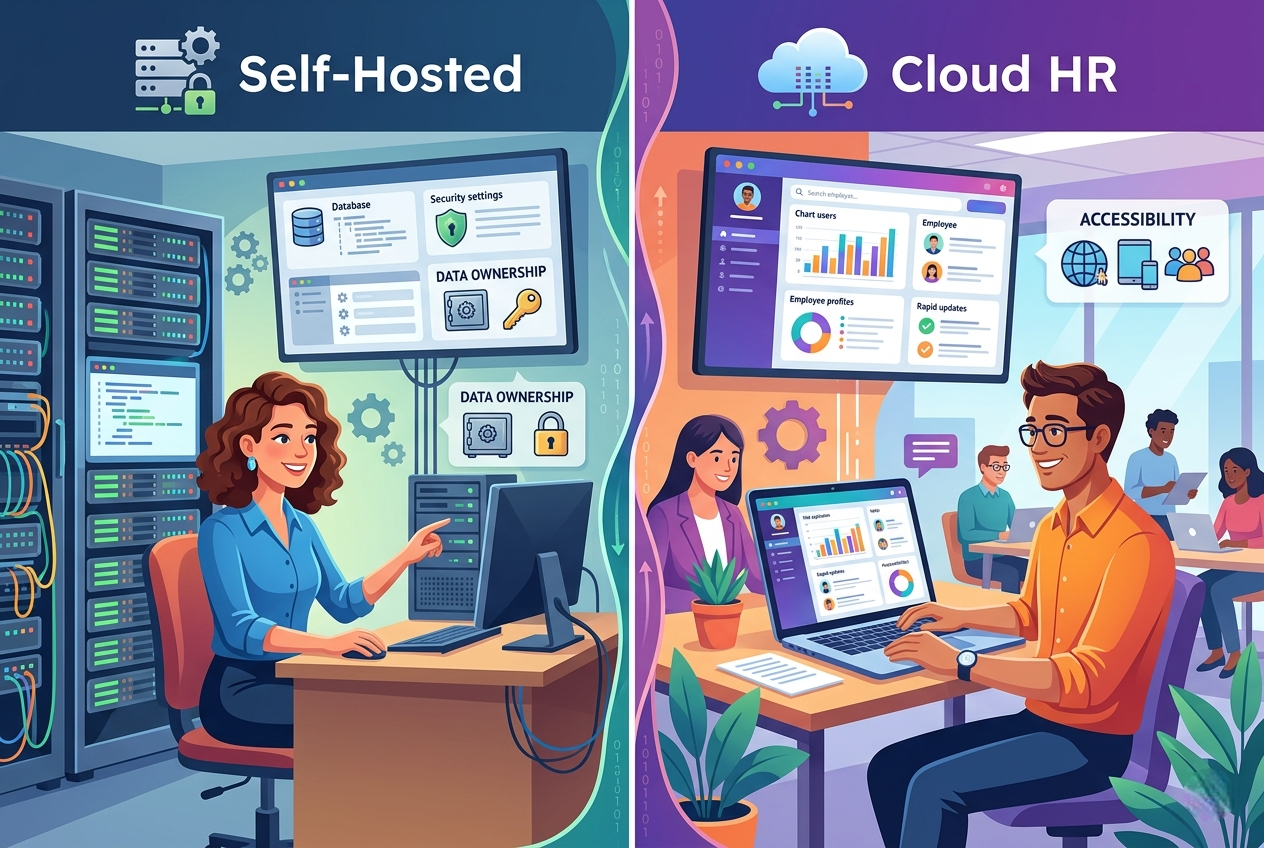
Stop paying for convenience you don't own. In 2026, the choice between Self-Hosted and Cloud HR is a battle for Digital Sovereignty. Compare the total cost of ownership, security, and scalability of the "SaaS Tax" versus a flat-fee, sovereign vault that keeps your employee data under your control....

IceHrm   Create your IceHrm, installation today.